
From Land Mapping to Mineral Mining: GIS-Driven Land Acquisition for Africa’s Mining Sector
17-Mar-2026Africa is one of the most resource-rich continents in the world. Countries such as Nigeria, Kenya, Tanzania, Ghana, South Sudan and South Africa host large deposits of gold, copper, lithium, cobalt, coal, rare earth minerals, and oil resources. Mining plays a vital role in these economies by creating employment, attracting foreign investment, and generating government revenue.
However, before mining operations begin, companies must first navigate land acquisition, land governance, and regulatory compliance. In many African countries, land ownership is complex because it involves government land, private land, and customary community land rights. According to global land governance studies, a large portion of land in Africa remains undocumented or poorly recorded, creating risks of disputes and delays in development projects.
To overcome these challenges, mining companies across Africa are increasingly adopting GIS-based land management systems and digital land acquisition platforms such as LAMS (Land Acquisition and Management System).
Land Acquisition Challenges in Africa’s Mining Sector
Mining projects often require thousands of hectares of land for exploration zones, extraction sites, processing plants, roads, and environmental protection areas. But acquiring this land is often difficult due to fragmented land governance systems.
Common challenges include:
1. Fragmented Land Records
Many African countries still rely on manual land registries and paper maps, making it difficult to verify ownership quickly.
2. Customary Land Ownership
In several African countries, especially Ghana and Nigeria, large areas of rural land are governed by traditional authorities or community systems rather than formal state records.
3. Multiple Government Agencies
Mining companies must interact with ministries responsible for land, mining, environment, and local administration.
4. Land Disputes and Boundary Conflicts
Poor cadastral mapping and unclear boundaries often lead to conflicts between mining companies and local communities.
5. Regulatory Compliance
Mining operations must follow national mining laws, environmental policies, and land acquisition regulations.
For example, Ghana regulates mining under its Minerals and Mining Act, which provides a legal framework for granting mineral rights and managing land used for mining activities.
These challenges make digital land governance and GIS-based cadastral mapping essential for modern mining operations.
Country-Specific Land Governance and Mining Context
Nigeria – Digital Land Administration and Mining Development
Nigeria is one of Africa’s largest economies and possesses mineral resources such as gold, iron ore, limestone, and lithium. Several states are digitizing land administration to improve transparency.
For example, the Gombe Geographic Information System was created to digitize land records and improve land acquisition processes in the state. It records land ownership, property valuation, and land management policies in a digital system.
For mining companies operating in Nigeria, GIS-based land management allows them to:
-
> Identify landowners and communities
-
> Track land acquisition progress
-
> Prevent illegal land encroachment
Kenya – Digital Land Systems Supporting Mining
Kenya has been modernizing its land governance through digital platforms.
The government launched the Ardhisasa National Land Information Management System, which digitizes land registration, title searches, and property transactions to improve land administration efficiency.
In addition, Kenya’s National Land Commission oversees public land management and investigates land disputes.
GIS technology is increasingly used in Kenya to map mining areas, land ownership, and environmental zones, allowing stakeholders to visualize mineral concessions and land rights within interactive digital maps.
Ghana – Structured Mining and Land Administration
Ghana is one of Africa’s leading gold producers and has a structured legal framework for mining and land administration.
Land and mineral resources are managed by the Ministry of Lands and Natural Resources (Ghana), which oversees land use, forestry, and mineral resource development.
To improve land governance, Ghana implemented the Land Administration Project (LAP), which introduced Customary Land Secretariats to record and manage land rights within traditional authorities.
However, the traditional land acquisition process can involve multiple agencies and lengthy administrative procedures, which often slows down development projects.
Tanzania – Expanding Mining Investment
Tanzania is rich in gold, diamonds, nickel, and graphite. The government has implemented several policies to improve land governance and mining regulation.
The Strategic Plan for Implementation of Land Laws and land administration systems aims to improve land registration and support resource development projects.
Mining companies operating in Tanzania often rely on geospatial mapping, satellite imagery, and cadastral mapping to identify land parcels and verify ownership before acquiring land.
South Sudan – Emerging Mining Economy
South Sudan has significant untapped mineral resources including gold, copper, and iron ore. However, land governance remains complex because land is often controlled by communities and traditional authorities.
Digital land management systems and GIS mapping can help governments and investors:
-
> Identify mineral-rich areas
-
> Map community land rights
-
> Manage mining concessions
-
> Reduce conflicts between communities and investors
South Africa – Mature Mining and Land Reform
South Africa has one of the most developed mining industries in Africa. The country’s land governance framework includes several programs related to land redistribution and land rights management.
Land acquisition policies such as the Proactive Land Acquisition Strategy (PLAS) were introduced to improve land access and support economic development.
GIS and spatial data systems are widely used in South Africa for:
- > Mining cadastre systems
-
> Environmental monitoring
-
> Infrastructure planning
-
> Land ownership mapping
Role of GIS in Mining Land Acquisition
Modern mining companies increasingly rely on Geographic Information Systems (GIS) for land management.
GIS allows companies to integrate multiple data layers, including:
-
> Satellite imagery
-
> Mineral resource maps
-
> Land ownership data
-
> Environmental zones
-
> Infrastructure networks
By combining these datasets, mining companies can visualize land assets, analyze terrain conditions, and make informed decisions about exploration and land acquisition.
GIS mapping also enables the creation of digital mining cadastre systems, where mining licenses, concession boundaries, and ownership details are stored within a centralized spatial database.
Why Africa Needs Digital Land Management Systems
Across Sub-Saharan Africa, fragmented land registries and manual record-keeping continue to create inefficiencies. Experts estimate that large portions of rural land remain undocumented or poorly recorded.
Digital land management systems can help governments and companies by:
-
> Centralizing land records
-
> Improving transparency in land transactions
-
> Preventing overlapping land claims
-
> Supporting sustainable land governance
How LAMS Supports Mining Land Acquisition in Africa
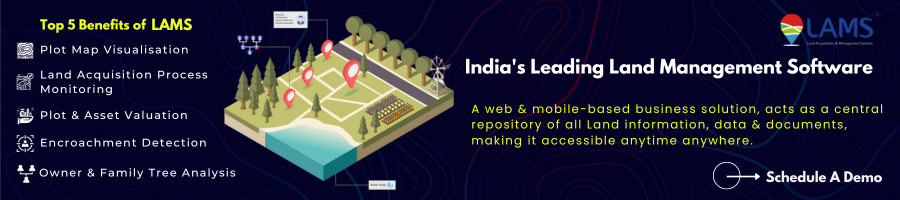
LAMS (Land Acquisition and Management System) is designed to digitize land administration and enable GIS-based land governance for large infrastructure and resource projects.
For mining companies operating in Africa, LAMS provides a unified platform for land acquisition, land record management, and spatial analytics.
Key Capabilities of LAMS
1. GIS-Based Land Parcel Mapping
LAMS enables mining companies to visualize land parcels, cadastral boundaries, and ownership information directly on GIS maps.
2. Digital Land Records Management
All land titles, lease agreements, survey maps, and legal documents can be stored in a centralized digital repository.
3. Mining Concession Mapping
Companies can visualise mining blocks, exploration zones, and infrastructure corridors throuh multiples GIS layers.
Land Acquisition Workflow Management
The platform tracks the entire acquisition lifecycle:
-
> Parcel identification
-
> Landowner verification
-
> Negotiation tracking (Customized)
-
> Compensation management
Encroachment Monitoring
Using satellite imagery and geotagged field surveys, companies can monitor mining land for illegal settlements or encroachments.
Benefits of GIS-Based Land Management for African Mining Companies
1. Faster Land Acquisition
Digital workflows significantly reduce the time required to acquire land parcels.
2. Reduced Land Conflicts
Accurate cadastral mapping minimizes disputes with communities and landowners.
3. Improved Regulatory Compliance
Mining companies can track permits, leases, and approvals across multiple agencies.
4. Better Decision Making
Geospatial analytics help companies evaluate mineral potential and environmental impacts.
5. Transparent Land Governance
Governments and investors can access reliable land records and concession data.
The Future of Mining Land Governance in Africa
As mining investments grow across Africa, governments are increasingly adopting digital land administration systems, mining cadastre platforms, and GIS-based mapping technologies.
Countries like Kenya, Ghana, Nigeria, and South Africa are already implementing land digitization initiatives to improve transparency and attract foreign investment.
In the coming years, technologies such as:
-
> GIS mapping
-
> Drone land surveys
-
> Satellite imagery
-
> Digital land registries
-
> Land management systems like LAMS
will play a crucial role in transforming how land is acquired, managed, and governed across Africa’s mining sector.
Conclusion
Mining development in Africa depends heavily on efficient land acquisition and transparent land governance. Countries such as Nigeria, Kenya, Tanzania, Ghana, South Sudan, and South Africa are gradually modernizing their land administration frameworks to support investment in mining and infrastructure.
GIS-based land management platforms like LAMS provide a powerful solution by combining digital land records, cadastral mapping, spatial analytics, and land acquisition workflow automation. By adopting these technologies, mining companies and governments can accelerate project development while ensuring responsible and sustainable land governance across Africa.
ABOUT THE AUTHOR

RELATED ARTICLES

Discover how Kenya’s digital land registry (Ardhi ..

LAMS is an integrated land information management ..

Global land planning market growth, digital land m ..